
AI Investment Is Accelerating. Human Capability Is What Makes It Pay Off.
A perspective for Talent Leaders on where the real value lives in the AI Era
- July 9, 2026
- 3 Minute Read
Every leadership team is asking some version of the same question right now: are we getting a return on our AI investment?
Two of the most comprehensive reports on the subject this year, the World Economic Forum’s Asia’s Human-led AI Opportunity and PwC’s Global AI Jobs Barometer, point to the same answer. It depends entirely on what’s built around the technology. Singapore sits right at the centre of that question. It depends entirely on what’s built around the technology. Singapore sits right at the centre of that question.
Investment is Racing Ahead
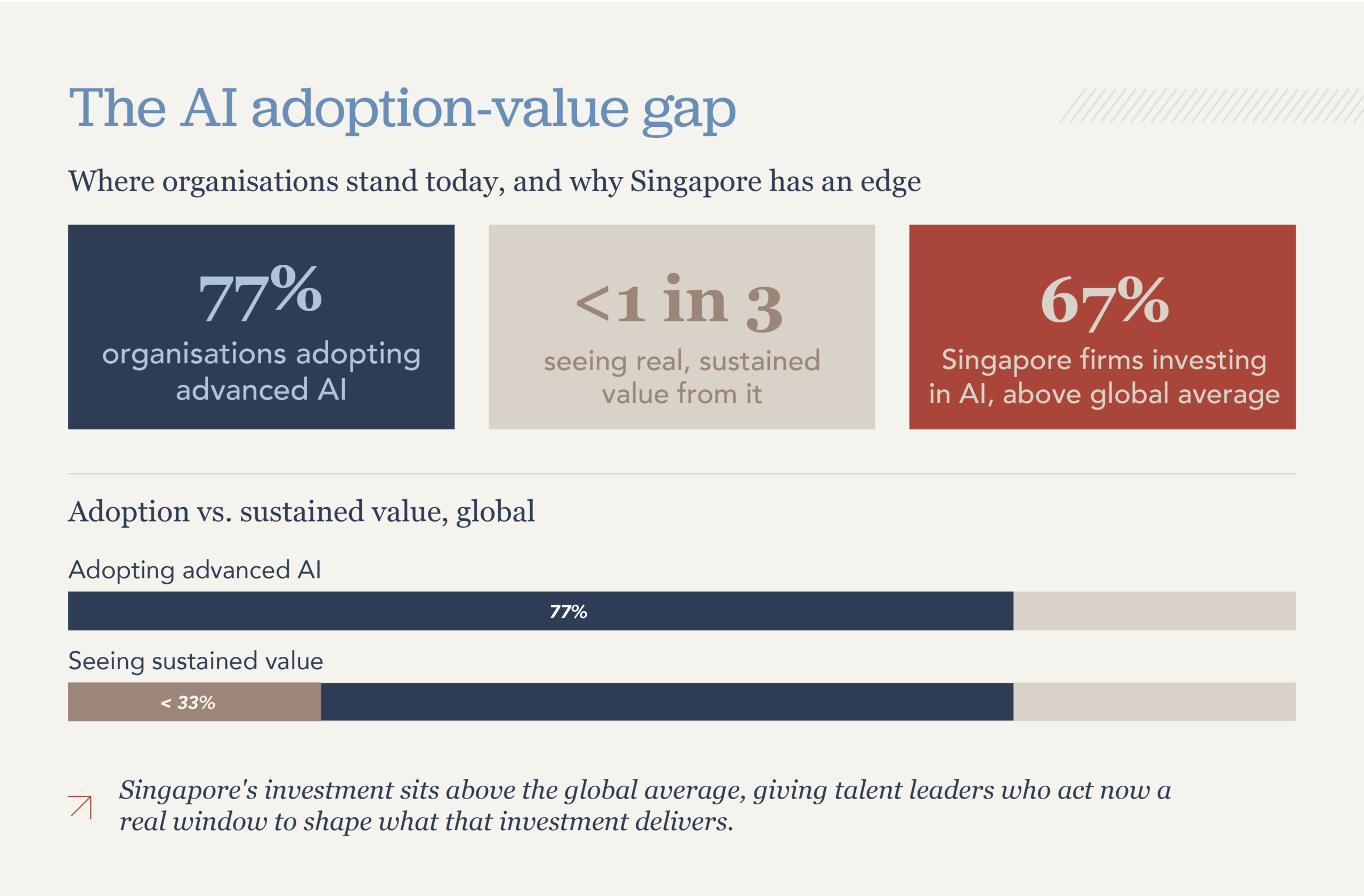
Singapore is investing ahead of the curve. 67% of Singapore businesses are investing in AI above the global average, and more than 80% of people across Singapore, China, Malaysia, Thailand, and Indonesia believe AI will profoundly change their lives within the next three to five years.
Regional intent is strong. Deployment is happening at pace. What varies enormously is what organisations get back for it, and the difference comes down to one thing.
Human Capability is What Makes it Pay Off
The companies seeing the strongest returns are not the ones automating hardest. They are the ones pairing AI with human skills like judgement and communication, and they’re being rewarded for it.
The top 20% of AI-ready companies saw labour productivity growth of 163%, nearly five times the average firm. Roles that combine AI proficiency with these human skills have grown 35% since 2019, and carry a wage premium of up to 118% in consumer markets.
The signal from both reports is consistent. Technical AI skill alone is not what’s being rewarded. It’s AI skill paired with human capability, and organisations that treat the two as separate investments are the ones leaving value on the table.

Human Skills are Becoming the New Baseline
One of the more striking findings is what AI adoption is doing to entry-level work. Roles exposed to AI are now 35% more likely to require competencies that used to be reserved for senior staff: judgement, empathy, ethics, creativity, leadership.
At the same time, 49% of CEOs expect AI to reduce junior hiring over the next three years, compared to just 12% who expect the same at senior levels.
Put together, this means the traditional apprenticeship, where junior employees learned judgement and leadership gradually through repetition and time in role, is disappearing. AI is absorbing the routine work that used to teach those skills. Human skills are no longer something people pick up eventually. These are the baseline expected from day one, and organisations can no longer assume people will develop them on the job. They have to be built deliberately, and earlier, than most training models currently allow for.
The Real Divide: Humans-with-AI vs. Humans-without-AI
The future of work was never going to be humans versus AI.
The data from both reports points to a different divide entirely: humans-with-AI versus humans-without-AI. The organisations pulling ahead are not winning because of better algorithms. They are winning because they’ve built the human capability to get more out of the same technology everyone else has access to.
It makes this a training and development question before it’s a technology question, and it’s one worth getting ahead of now, while the gap between adoption and value is still wide enough to be a genuine advantage for whoever closes it first.
The right starting point depends on your workforce, your priorities, and your timeline. If you’d like to talk through where to start, get in touch with the Eagles Flight team or explore our leadership and capability programmes.
The organisations that get ahead of this won’t wait for the divide to widen before they act. If you’re thinking about where human capability building fits into your AI roadmap, we’d welcome the conversation.
References:
- World Economic Forum, Asia’s Human-led AI Opportunity: A Framework for Transformation (2026)
- PwC, 2026 Global AI Jobs Barometer (2026)